1-scaled.png)
School Desk Dimensions Guide by Student Age Group for Institutional Procurement
Getting desk dimensions wrong in a school furniture order is not a cosmetic issue — it creates ergonomic non-compliance, exposes the institution to liability, and can disqualify units from regulated procurement environments.
For procurement officers specifying school desk and chair configurations across multiple grade levels, dimension accuracy is the first specification control point, not a secondary consideration.
This guide maps desk and chair dimensions to student age groups using EN 1729 Part 1 and ISO 5970 size categories, and explains how each measurement translates into an RFQ line item.
For broader procurement planning — supplier qualification, certifications, budget frameworks, and delivery scheduling — refer to the school furniture procurement checklist.
1. The Standards That Govern School Desk Dimensions
Two primary international standards define school furniture dimensions for institutional procurement. Both use a size category system that links student body height to desk and chair height ranges — allowing specifications to be written in measurable, verifiable criteria rather than approximate age descriptors.
EN 1729 Part 1 — Functional Dimensions for Educational Furniture
EN 1729 Part 1 is the European standard establishing functional dimensions for chairs and tables used in educational institutions. It defines seven size categories — Size 1 through Size 7 — based on student body height, with corresponding seat height, desk height, seat depth, seat width, and backrest height requirements for each category.
This is the primary dimensional reference for school furniture procurement across European markets and is widely adopted as a specification benchmark in international institutional procurement including the Middle East and North Africa.
ISO 5970 — International Size Classification for School Furniture
ISO 5970 provides an internationally recognized size classification covering Size 1 through Size 6, with corresponding body height ranges and recommended desk and seat heights.
It is commonly referenced in procurement specifications for markets where EN standards are not the primary regulatory framework. Both ISO 5970 and EN 1729 Part 1 use comparable size logic and can be cross-referenced when preparing RFQs for international supply chains — confirm with your supplier which standard applies to the destination market before finalizing the specification.
EN 1729 Part 2 — Structural Strength and Durability
EN 1729 Part 2 covers structural safety and durability testing — separate from but always required alongside Part 1. A supplier holding Part 1 certification only has not completed the full compliance test protocol for contract-grade institutional school furniture.
Procurement officers must require test certificates for both parts from accredited third-party laboratories such as SGS, TÜV, Intertek, or Bureau Veritas.
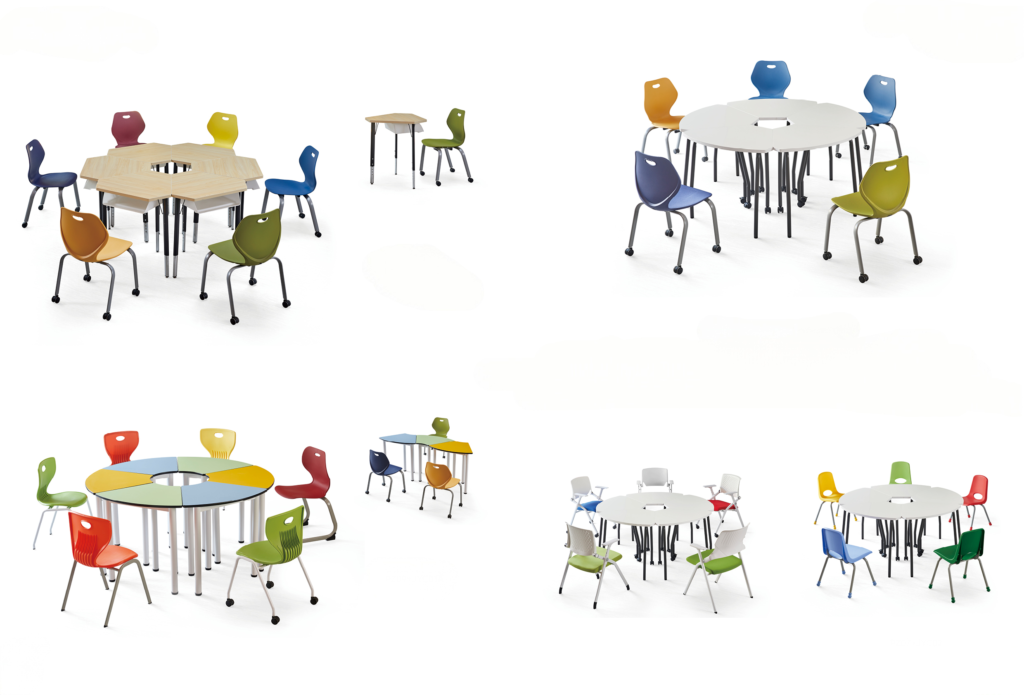
2. School Desk and Chair Dimensions by Student Age Group
The size categories below are mapped to approximate student age groups for procurement planning purposes. Body height is the definitive criterion — age is a planning approximation only.
Size Categories 1–3: Early Childhood to Lower Primary (Ages 3–9)
- Size 1 — Body height up to 930mm (ages 3–5): desk height 460mm, seat height 260mm.
- Size 2 — Body height 930mm–1,080mm (ages 5–7): desk height 520mm, seat height 310mm.
- Size 3 — Body height 1,080mm–1,210mm (ages 7–9): desk height 590mm, seat height 350mm.
Procurement teams specifying furniture for lower primary classrooms with mixed ages across this range typically require a two-size specification — Size 2 and Size 3 — to maintain EN 1729 Part 1 compliance across the full student body height spread.
Size Categories 4–5: Upper Primary to Lower Secondary (Ages 9–14)
- Size 4 — Body height 1,210mm–1,350mm (ages 9–12): desk height 640mm, seat height 380mm.
- Size 5 — Body height 1,350mm–1,500mm (ages 12–14): desk height 710mm, seat height 430mm.
These two size categories represent the highest-volume specification range in most K-12 institutional procurement projects.
For schools specifying a single desk size to serve a mixed upper-primary cohort, Size 4 is the most commonly adopted compromise — however, this should be documented in the specification as an accepted deviation and confirmed with the supplier in writing.
Size Categories 6–7: Upper Secondary and Adult Use (Ages 14+)
- Size 6 — Body height 1,500mm–1,660mm (ages 14–17): desk height 760mm, seat height 460mm.
- Size 7 — Body height above 1,660mm (ages 17+ and adult learners): desk height 820mm, seat height 510mm.
Size 6 is the standard specification for upper secondary general classroom use. Size 7 is reserved for adult education, vocational training, and university seminar environments.
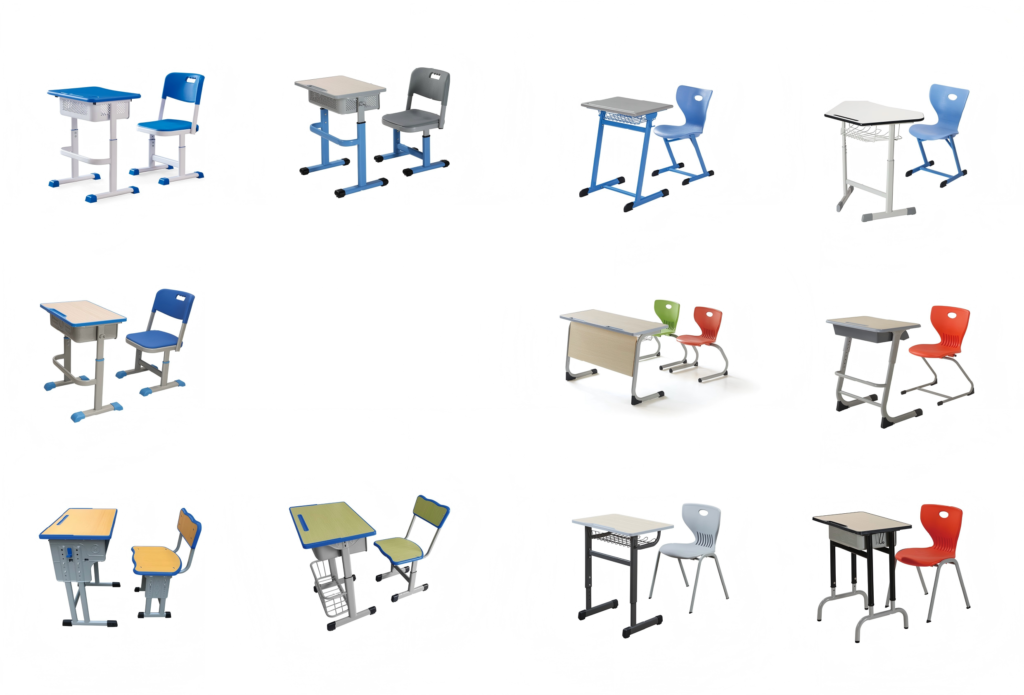
View available configurations across these size categories in the school desk and chair product range.
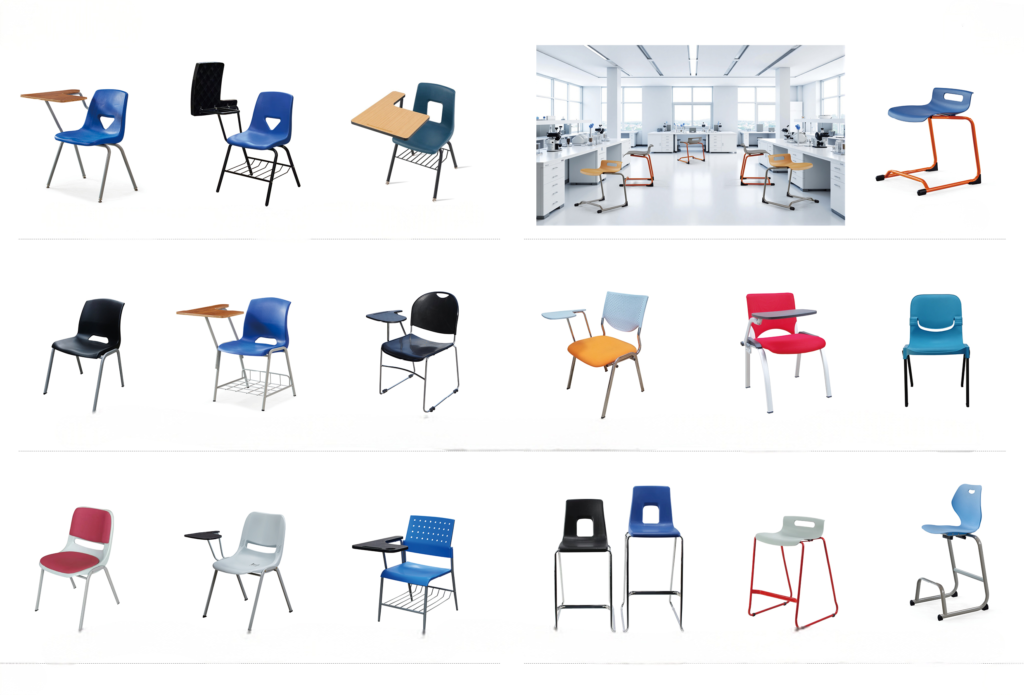
3. Chair Dimensions That Must Be Specified Alongside Desk Height
Chair dimensions must be specified in coordination with desk dimensions — not independently. A correctly specified desk paired with an incorrectly specified chair creates an ergonomic mismatch that EN 1729 Part 1 is designed to prevent.
Seat Height by Size Category
Seat height is the primary chair dimension variable and must correspond directly to the desk height for the same size category.
Specifying only desk height without a corresponding seat height reference is an incomplete specification that creates compliance gaps at delivery inspection. Include both measurements as separate line items in the RFQ for each size category ordered.
Seat Depth and Width Minimums
For Size 3 through Size 5 — the most common school procurement range — EN 1729 Part 1 requires a minimum seat depth of 300mm and seat width of 310mm. For Size 6 and Size 7, minimums increase to 350mm depth and 360mm width.
These dimensions should be included in the RFQ specification alongside seat height — not assumed to be implied by the size category reference alone.
Backrest Height by Size Category
EN 1729 Part 1 specifies minimum backrest height ranging from 210mm for Size 1 to 360mm for Size 7.
For procurement orders covering Sizes 4 through 6, backrest height is a frequently omitted specification point that suppliers may vary significantly if not explicitly stated. Include minimum backrest height as a line item in the dimension specification sheet.
4. The Seat-to-Desk Height Differential: The Critical Ergonomic Ratio
The seat-to-desk height differential — the vertical distance between the seat surface and the desk surface — is the most important ergonomic relationship in school furniture specification. EN 1729 Part 1 requires this differential to fall between 200mm and 250mm across the main K-12 size groups.
Why the Differential Must Be Explicitly Verified
A desk and chair that individually meet dimensional requirements can still fail ergonomic compliance if the seat-to-desk differential falls outside the standard range.
This occurs most commonly when procurement teams mix size categories — specifying a Size 5 desk with a Size 4 chair — or when adjustable furniture is set to positions outside the calibrated range.
State the required differential range explicitly in the RFQ and require the supplier to confirm that all quoted desk-chair combinations achieve it within the specified adjustment range.
Fixed vs. Adjustable Height: Differential Implications
Fixed-height furniture maintains a constant differential aligned to a single size category. Adjustable-height furniture allows seat and desk height to be varied independently — creating a risk that the differential may be set outside the compliant range during classroom use.
For adjustable-height specifications, require that the adjustment mechanism includes calibration markers aligned to EN 1729 Part 1 size categories so that correct differential settings can be verified by classroom staff without specialist equipment.
5. Desktop Material Dimensions and Surface Specifications
Desk height is only one dimension criterion. Desktop panel thickness and surface material must also be specified to ensure structural performance over the expected replacement cycle of 7–10 years in contract-grade school environments.
Minimum Desktop Thickness for Institutional Use
Institutional school desks should specify a minimum desktop thickness of 18mm using E1-grade particleboard or MDF with melamine surface finish, compliant with EN 13986 formaldehyde emission limits.
Thinner desktop panels — commonly 15mm or 16mm — are used in lower-grade commercial furniture and do not provide sufficient structural rigidity for high-use classroom environments.
Desktop edge treatment should be specified as ABS or PVC edge banding at a minimum 1mm thickness to prevent delamination under normal use.
Frame Dimensions and Finish Specification
Metal frame components for school desks are typically 25×25mm or 30×30mm square-section steel tube. Frame surface treatment should be specified as electrostatic powder coating to a minimum 60–80 micron thickness for corrosion resistance in high-humidity classroom environments.
Include frame dimensions and powder coat thickness as explicit line items in the RFQ — not as generic “steel frame” descriptors — to ensure all responding suppliers are quoting against identical structural criteria.
6. Translating Dimension Standards Into an Institutional RFQ
Referencing EN 1729 Part 1 in an RFQ is necessary but not sufficient.
A procurement-ready dimension specification must translate the standard into explicit, measurable line items that leave no room for supplier interpretation. For the full RFQ preparation process — including supplier qualification criteria and documentation requirements — refer to the school furniture procurement checklist.
Structuring the Dimension Specification Sheet
A compliant RFQ dimension specification for each size category ordered should include:
EN 1729 Part 1 or ISO 5970 size category reference, desk height in millimetres, seat height in millimetres, minimum seat depth and width, minimum backrest height, required seat-to-desk differential range (200–250mm), desktop panel thickness and material grade, and frame tube dimensions and powder coat specification.
Every item should be a fixed measurement or defined range — not a qualitative descriptor.
Specifying Multiple Size Categories in One Order
School furniture orders covering multiple grade levels require a separate specification line for each size category with its own unit quantity. A primary school covering Grades 1 through 6 may require Size 2, 3, and 4 units in different quantities per category.
Suppliers bidding on multi-size orders must confirm they can maintain finish code consistency across all size categories within the same production batch — a critical requirement for visual uniformity across a multi-grade campus rollout.
Manufacturers like ONMUSE that document finish codes and size category production records across institutional orders give procurement teams the batch verification data needed to confirm consistency at delivery, particularly across phased multi-building rollouts.
Start Your School Desk Specification Project
Send ONMUSE your grade level breakdown, required EN 1729 size categories, order quantity per category, and target delivery date. The ONMUSE team will prepare a dimension-compliant school furniture quotation with full EN 1729 Part 1 and Part 2 certification documentation included as standard.
Submit your RFQ here and receive a specification-ready quotation for your institutional school furniture project.
FAQs about School Desk Dimensions
Q1. Which EN 1729 size category should we specify for 10-year-old students?
A 10-year-old typically falls within EN 1729 Part 1 Size 4 (body height 1,210–1,350mm, desk height 640mm, seat height 380mm). Verify actual grade-level height distributions before ordering, since students in one grade can span more than one size category.
Q2. What is the EN 1729 desk and seat height range for primary school furniture?
Primary school furniture covers Sizes 2–4, with desk heights from 520mm to 640mm and seat heights from 310mm to 380mm. This spans body heights of 930–1,350mm, roughly ages 5–12.
Q3. What seat-to-desk height differential does EN 1729 require?
EN 1729 Part 1 requires a 200–250mm seat-to-desk differential across the main K-12 sizes, for both fixed and adjustable furniture. For adjustable units, specify calibration markers aligned to EN 1729 categories so staff can verify correct settings.
Q4. Does ONMUSE supply school desks across multiple EN 1729 size categories?
Yes. ONMUSE supplies school desks and chairs across multiple EN 1729 Part 1 size categories for primary, secondary, and higher education orders. Explore the school desk and chair range, or send your grade level breakdown to confirm the size categories for your RFQ.
Q5. What certification documents should a school desk supplier provide?
Require EN 1729 Part 1 dimension certificates, EN 1729 Part 2 structural test reports from an accredited lab (SGS, TÜV, Intertek, or Bureau Veritas), and EN 13986 E1 emission documentation for all wood-based panels. Self-declared compliance statements are not accepted as equivalent to third-party certification.
Q6. What is the minimum desktop thickness for institutional school desks?
Specify a minimum 18mm desktop in E1-grade particleboard or MDF with melamine finish, compliant with EN 13986. Thinner 15–16mm panels suit lower-grade commercial furniture and won’t sustain a 7–10 year institutional replacement cycle.
Q7. Can one desk size cover multiple grade levels in a single order?
Only where the grades’ body heights fall within the same EN 1729 size category. Mixed-age or multi-grade orders usually need two or more sizes — forcing one size across a wide age range creates ergonomic non-compliance and compliance risk at the height boundaries.
Q8. How should desk dimensions be written into a bulk RFQ?
List each size category as a separate SKU line with its EN 1729 reference, desk and seat height, seat depth and width, backrest height, differential range, and material spec. Blending multiple sizes into one RFQ line prevents objective supplier comparison and creates verification gaps at delivery.