Classroom Furniture Planning Guide for Modern Schools
Classroom furniture planning directly determines how much usable floor space a room delivers, whether the layout supports the intended teaching model, and whether installation can be completed on schedule around a renovation or construction handover.
For procurement officers and project managers, layout decisions made before the RFQ is issued affect both the specification and the delivery sequence — not just the aesthetics of the finished room.
This guide covers classroom space allocation standards, layout configurations by teaching model, STEM and flexible learning environments, phased installation planning, and the coordination steps required to move from approved specification to fully installed classroom. As a school furniture manufacturer and supplier, ONMUSE produces the full classroom range — from school desks and chairs to auditorium seating and student apartment beds — to the dimension and finish standards covered below.
1. Classroom Space Allocation Standards for Institutional Planning
Space allocation is the first calculation in classroom furniture planning.
The number of students a room can accommodate safely and ergonomically is determined by floor area — not by how many desks can be physically fitted into the space.
Minimum Floor Area Per Student
Institutional school design standards typically require 1.5m² to 2.0m² of usable floor area per student for standard classroom configurations. This allocation covers the desk footprint, chair clearance, and the minimum movement space required for a seated student.
A standard 30-student classroom requires a usable floor area of 45–60m² at this allocation rate — before aisle widths, teacher circulation space, and fixed storage are factored in.
Standard Classroom Footprint and Furniture Capacity
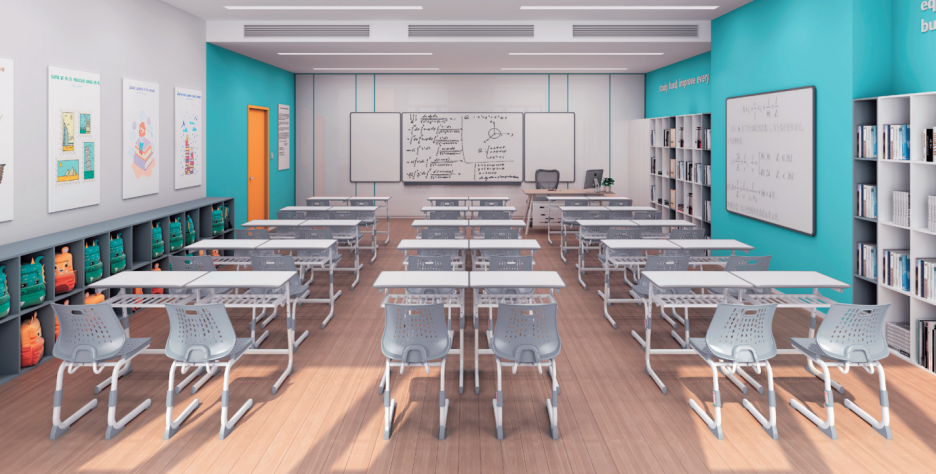
A typical classroom footprint of 56–72m² will comfortably accommodate 28–32 student desk-and-chair sets in a standard row configuration, with adequate aisle clearance and a teacher workstation at the front.
The footprint of each school desk and chair set is the core variable here — confirm the actual unit dimensions before fixing room capacity, since a deeper or wider desk reduces the number of sets a room can hold.
Rooms below 50m² of usable floor space should not be planned to 30-student capacity — furniture density above the minimum allocation standard increases movement obstruction and creates fire egress risk.
Procurement teams planning furniture for rooms below standard footprint should reduce the unit count and document the adjusted capacity in the project specification file.
Accounting for Fixed Elements in Floor Area Calculations
The following fixed elements must be subtracted from the gross room area before the usable floor area calculation is made:
- Column positions
- Radiator housings
- Window sill projections
- Built-in storage
A 63m² room with two structural columns and perimeter radiator housings may have a usable planning area of 54–56m² — enough for 27–28 desks at the 2.0m² allocation standard, not 31.
Project managers must obtain confirmed architectural drawings showing fixed element positions before finalizing furniture quantity plans.
2. Aisle Clearance and Circulation Standards
Aisle clearance is a fire egress and access compliance requirement — not a space optimization variable.
Minimum aisle dimensions are non-negotiable in any occupied educational space and must be maintained regardless of the furniture layout model chosen.
Minimum Aisle Width Requirements
The minimum clear-width standards for occupied educational spaces are:
- Primary circulation aisles (connecting directly to room exits): minimum 900mm to comply with standard fire egress requirements.
- Secondary aisles (between rows or clusters): minimum 600mm to allow student movement and teacher access.
These measurements are clear distances between furniture edges — not between desk centrelines. Desk and chair dimensions, including pulled-out chair positions, must be factored into the aisle calculation at the layout planning stage.
Teacher Circulation and Front-of-Room Clearance
A clear front-of-room circulation zone of minimum 1,200mm between the teacher workstation and the first student desk row should be maintained in all standard layout configurations. This clearance supports teacher movement, interactive teaching, and equipment access.
In rooms with projection screens or interactive whiteboards at the front wall, this zone also prevents student desk surfaces from being positioned within the screen sight line of rear-row students.
Layout Review Before Furniture Order Is Confirmed
A scaled floor plan with furniture positioned to dimension — not to rough approximation — must be reviewed and approved before the purchase order is placed.
Layout plans adjusted after delivery to resolve aisle clearance or capacity issues cannot be fixed without returning or exchanging furniture units.
Treat the layout sign-off as a procurement milestone, not a post-delivery task.
3. Layout Configurations by Teaching Model
Different teaching models require different furniture layouts.
A classroom configured for lecture-style instruction cannot be repurposed for collaborative group work without significant reconfiguration — unless the furniture specification anticipates multi-mode use from the outset.
Traditional Row Configuration
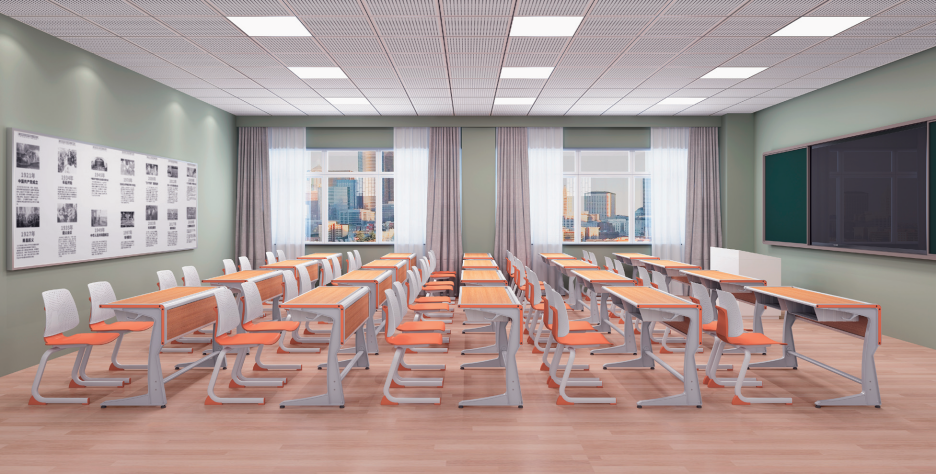
The traditional row layout positions individual student desks in parallel rows facing the teacher workstation. This configuration maximizes student capacity per unit of floor area and supports direct instruction, examination conditions, and standardized testing environments.
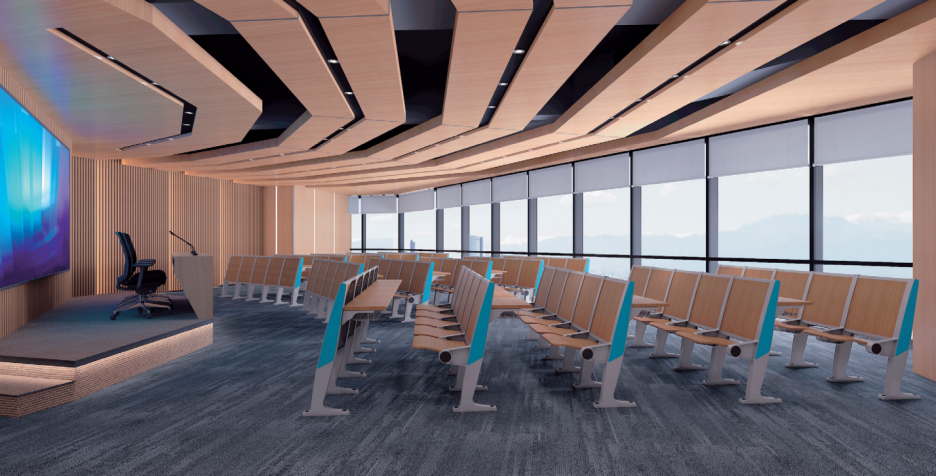
For large secondary schools or examination halls requiring maximum seating density, the row configuration is the highest-efficiency layout option and the most straightforward to specify and install. Where fixed-seat density is the priority — for example a lecture theatre or assembly hall — auditorium chairs deliver higher seating density than free-standing desk-and-chair sets.
Collaborative Cluster Configuration
Collaborative cluster layouts group desks in sets of 4–6, arranged so students face each other within the group. This supports project-based learning, group discussion, and peer learning models.
It requires approximately 15–20% more floor area per student than a row configuration to maintain adequate aisle clearance between clusters, which directly affects the maximum unit count for a given room.
Procurement teams specifying cluster layouts should include this space premium in the capacity calculation before finalizing unit quantities.
U-Shape and Seminar Configurations
U-shape arrangements position desks around the perimeter of the room with an open central space, supporting seminar-style discussion and teacher-centred interaction.
This configuration is best suited to smaller class groups of 15–20 students and rooms with a minimum footprint of 50m².
The open centre means a U-shape layout delivers the lowest student density per square metre of any standard configuration — it should not be specified for full-cohort classes of 28–30 students.
4. STEM and Flexible Learning Classroom Furniture Planning
STEM classrooms and flexible learning environments place different demands on furniture specification than standard academic classrooms.
The furniture must support rapid reconfiguration between individual work, group experiments, and demonstration modes — often within a single teaching session.
STEM Laboratory Furniture Requirements
STEM laboratory furniture requires bench desks with a minimum surface depth of 750mm–900mm to accommodate practical equipment, specimen trays, and shared materials alongside standard writing space.
The standard desk depth of 500–600mm used in academic classrooms is insufficient for practical science or technology work. Compare the depth options across the school desk and chair range against your lab requirement before specifying.
Procurement teams must identify bench depth requirements during the space planning phase — not during the RFQ review — as this directly affects room capacity, unit footprint, and available aisle clearance.
Flexible Learning Multi-Mode Furniture
Flexible learning spaces require furniture that can transition between row, cluster, and open-floor configurations without tools or specialist effort. This typically means:
- Lightweight individual desk units with caster options
- Stackable chairs
- Modular components that can be reconfigured by classroom staff
Confirm maximum stacking height and storage footprint for reconfigured units — furniture that cannot be stored efficiently within the room defeats the purpose of a flexible layout.
Breakout and Ancillary Learning Spaces
Multi-building school projects often include ancillary breakout areas, library zones, and informal learning spaces alongside standard classrooms. These require different furniture categories:
- Soft seating
- Low tables
- Standing-height collaborative benches
Boarding and campus projects also extend beyond the classroom into residential blocks, where student apartment beds are specified to the same finish and durability standards as the teaching furniture.
These should be planned within the same procurement exercise as classroom furniture to ensure finish code consistency across the building.
Sourcing ancillary and classroom furniture from the same supplier is the most reliable way to maintain visual coherence across a campus rollout. Explore the full school furniture range for available configurations across both standard and flexible learning environments.
5. Space Utilization and Capacity Planning Across a Multi-Room Project
Single-classroom planning is straightforward.
Multi-room, multi-building, or phased campus projects require a structured capacity planning approach to keep unit quantities, size categories, and finish specifications consistent across the full project scope.
Room-by-Room Capacity Schedule
A room-by-room capacity schedule documents every space to be furnished. For each room, record:
- Student age group and corresponding EN 1729 size category
- Confirmed unit count per room
- Desk and chair configuration
- Finish codes selected
This schedule is the master planning document that drives the RFQ unit quantities. Teams that skip this step and estimate at building level regularly encounter shortfalls or surpluses at installation.
Refer to the school desk dimensions guide for EN 1729 size category specifications by student age group to complete the size category column accurately.
Finish Code Consistency Across Multiple Rooms
Finish code consistency across rooms, floors, and buildings is a procurement control requirement for institutional school projects. Where multiple classrooms are refurnished in a single project, all units must be produced within the same finish specification:
- RAL codes for frame powder coat
- Laminate reference codes for desktop surfaces
Manufacturers like ONMUSE that maintain documented finish codes and production batch records provide the verification data teams need to confirm consistency across a multi-room rollout — particularly where deliveries are phased across multiple purchase orders.
Quantity Buffer Planning for Large Projects
School furniture projects of 500 units or more should include a quantity buffer of 3–5% above the confirmed room-by-room count, to cover installation breakage, on-site measurement adjustments, and future classroom additions.
Buffers should be specified within the original purchase order rather than as a secondary order — a secondary order placed after installation may not achieve an identical finish match if production batch codes have changed.
6. Project Sequencing and Phased Installation Planning
Multi-building school furniture projects require a structured installation sequence aligned to construction handover dates, site access windows, and academic calendar constraints.
Installation planning that is not coordinated with the construction programme is one of the most common causes of project delays in institutional school fit-outs.
Aligning Furniture Delivery to Construction Handover
Furniture delivery should be scheduled no earlier than 5–7 days after confirmed construction handover for each building or zone.
Delivering into a space that has not been handed over from the contractor creates storage pressure, increases the risk of damage to uninstalled units, and may obstruct remaining construction work.
Project managers must obtain confirmed handover dates from the construction programme before agreeing furniture delivery windows with the supplier.
Phased Delivery Scheduling for Multi-Building Campuses
For projects covering multiple buildings with staggered handover dates, split purchase order scheduling lets furniture production proceed for the full project while delivery is phased to match construction progress.
This requires written agreement at contract stage, covering:
- Confirmed delivery windows per building
- Agreed storage terms for units produced ahead of schedule
- A clearly documented process for quality verification at each delivery phase
Verbal phasing agreements made after the purchase order is placed are unenforceable and a leading cause of institutional project disputes.
Installation Sequencing Within a Single Building
Within a single building, sequence installation as follows:
- Upper floors to lower floors where elevator access is required
- Furthest rooms to nearest rooms from the building entrance, to avoid moving installed furniture to access deeper spaces
Room-by-room installation should be completed and signed off before moving to the next room. Partial installation across multiple rooms simultaneously creates inventory control problems and increases the risk of unit misallocation between rooms with different size category requirements.
Start Your Classroom Furniture Planning Project
Whether you are furnishing a single building or phasing a full campus rollout, ONMUSE supports schools, contractors, and distributors with:
- Layout-ready school desk and chair configurations
- High-density auditorium seating for halls and lecture theatres
- Matching student apartment beds for campus residential blocks
- Batch-consistent production across multi-room orders, with phased delivery aligned to your construction programme
Submit your classroom furniture RFQ with your room-by-room capacity schedule, grade level breakdown, required size categories, and target installation date.
The ONMUSE team will prepare a specification-ready quotation and full project documentation package.
For related references:
- For procurement process steps, supplier qualification, and documentation requirements, refer to the school furniture procurement checklist.
- For EN 1729 desk and chair dimension specifications by student age group, refer to the school desk dimensions guide.
FAQs about Classroom Furniture Planning
Q1. Can ONMUSE help plan classroom layouts before we issue the RFQ?
Yes. Send your room dimensions and target capacity, and our team confirms unit counts that meet the 1.5–2.0m² per-student allocation and 900mm fire-egress aisle standard — so your quantities match what the rooms can actually hold. See the school furniture procurement checklist for the full process.
Q2. What is the MOQ for a multi-classroom or campus order?
ONMUSE handles orders from single-building fit-outs to full campus rollouts.Send your room-by-room capacity schedule to confirm minimum order quantity, production capacity, and lead time for your delivery window.
Q3. Can deliveries be phased to match our construction handover dates?
Yes. We support split purchase order scheduling — production runs for the full project while delivery is phased per building, with storage terms agreed in writing.Send your construction programme to align delivery windows.
Q4. How does ONMUSE keep finishes consistent across phased orders?
We maintain documented RAL and laminate finish codes with batch records, so later phases match the first batch.Specify a 3–5% buffer in the original PO to avoid finish mismatch on a re-order.
Q5. Does ONMUSE supply furniture for STEM labs and flexible learning rooms?
Yes — standard classrooms, STEM labs (750–900mm bench depth), and flexible rooms with caster desks and stackable chairs.Browse the school desk and chair product range, or send your room-type breakdown for the right specification.
Q6. What documentation does ONMUSE provide for a school furniture tender?
We supply EN 1729 test reports, E1 (EN 13986) certificates, and finish code records as standard in the RFQ package. Contact the ONMUSE team with your specification sheet to get a quotation and the full certification document pack.