How to Specify Auditorium Chairs for Institutional and Educational Projects
Auditorium chairs are a high-visibility, high-traffic purchases where small specification misses turn into long punch lists, user complaints, and premature repairs.
For institutional and educational buyers, the goal is to balance capacity planning with comfort, accessibility, durability, and long-term serviceability—while making sure the seating integrates cleanly with the room’s layout, AV needs, and event types.
Why Auditorium Seating Requires Project-Specific Planning
Auditoriums, lecture halls, and assembly spaces are not interchangeable. Seating that performs well for 50-minute lectures may frustrate users during multi-hour events, and a solution designed for a quiet recital venue may not hold up in a high-turnover student space.
Balancing Capacity, Comfort, and Space Efficiency
Most projects start with seat count, but seat count alone doesn’t define success. Row pitch, seat width, aisle strategy, and entry/egress flow determine whether the room feels comfortable and usable—or cramped and noisy.
Procurement teams often get better outcomes when they treat capacity as one variable within a wider performance target: acceptable comfort for the typical event duration, circulation that supports fast turnover, and a layout that doesn’t compromise sightlines or accessibility to “fit in” extra seats.
Responding to the Needs of Educational and Institutional Venues
Educational venues commonly shift use throughout the year: lectures, testing, guest speakers, orientations, performances, and community events. Institutional venues may also host donor events or public programming where comfort and perceived quality carry reputational weight.
That’s why auditorium chair specifications often need to address optional functionality (like tablet arms for note-taking), noise behavior during movement, and maintenance planning for heavy use.
Many project teams start by aligning on the seating category and intended use, then narrowing down options within an auditorium seating range such as Onmuse auditorium chairs to keep finishes and performance expectations consistent.
For more options, you can explore our auditorium chairs collection.
Key Specification Factors for Auditorium Chairs
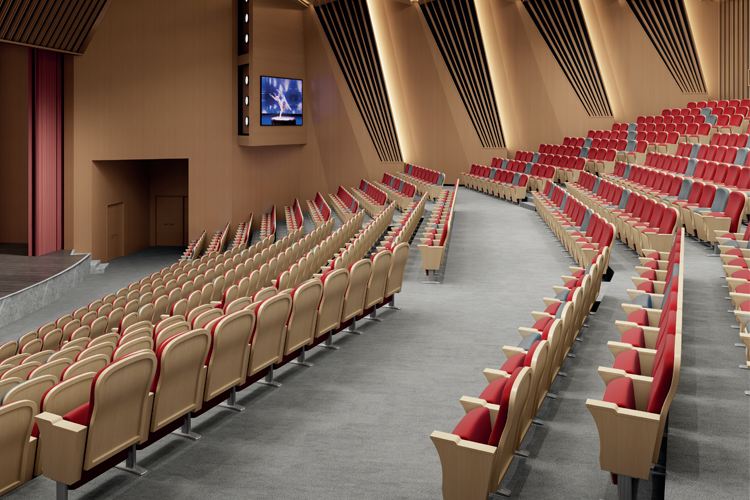
A strong auditorium chair specification reads like a project decision document, not a brochure. It translates layout and user expectations into clear requirements that designers, installers, and suppliers can execute consistently.
Row Layout, Sightlines, and Space Planning
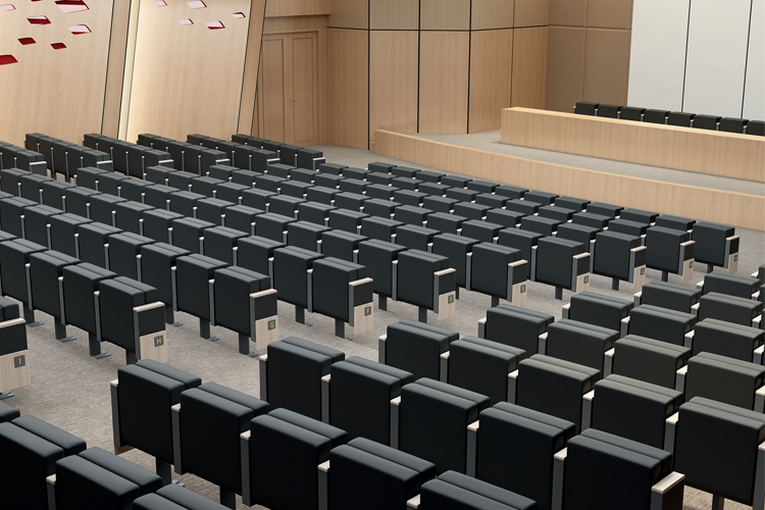
Auditorium seating lives inside the geometry of the room. Seat selection should be coordinated with row curvature (if any), riser heights, aisle placement, and egress requirements. When these elements are handled late, teams end up making compromises that impact comfort or compliance.
From a procurement perspective, it helps to confirm early whether the project needs fixed seating with defined row spacing, whether tablet arms affect clearances, and whether the room needs special planning for front-row access, instructor movement, or camera sightlines for recording.
Material Durability for High-Traffic Use
Institutional seating fails in predictable places: arm caps, seat pans, hinges, fasteners, and surfaces that get scuffed during entry/exit. Durability should be evaluated against how the venue is used, how often it’s cleaned, and whether the seating experiences daily turnover.
The best long-term specs also consider repair reality. If a part is damaged, can it be replaced without removing multiple seats? Are wear components standardized? Is the finish likely to show scratches immediately? Asking these questions upfront reduces long-term operational cost.
For large projects, standardizing reliable auditorium seating solutions can help reduce long-term maintenance risks.
Comfort, Noise Control, and User Experience
Comfort in an auditorium isn’t luxury—it’s attention span. If seats are too tight, squeaky, or uncomfortable, users shift, stand, and move more often, increasing noise and distraction.
Noise control matters more than many buyers expect. Seat return mechanisms, hinge tolerances, and contact points influence whether the room stays quiet during late arrivals and mid-session exits.
If the venue supports note-taking, tablet arms can also be part of the user experience.
A configuration like an auditorium chair in grey with a writing pad can be relevant in lecture-heavy environments where students need a reliable surface without adding separate tables.
Accessibility and Inclusive Seating Design
Accessibility should be integrated into the layout and the seating plan, not treated as a last-minute adjustment. Inclusive design includes wheelchair locations with appropriate companion seating, accessible routes and sightlines, and thoughtful distribution so accessible seating isn’t isolated or limited to less desirable areas.
On many campus projects, inclusive planning also intersects with multipurpose use—spaces may need to convert for events, reserved seating, or temporary equipment. Good specifications reflect that reality and make it easier to operate the venue without improvisation.
Common Mistakes in Auditorium Chair Specification
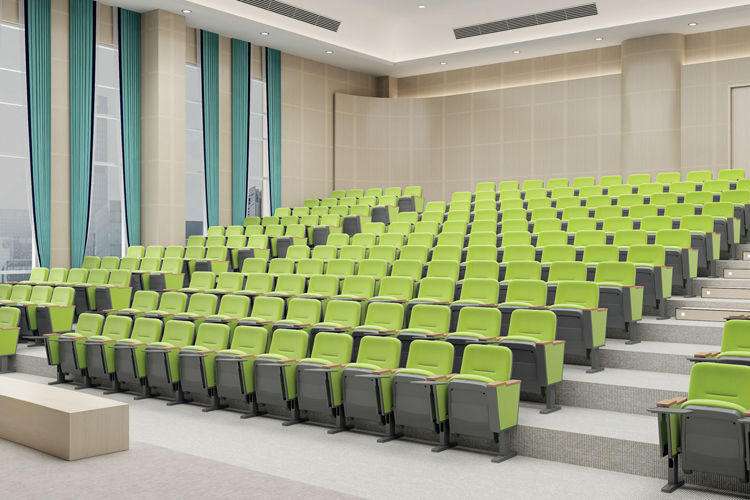
Many auditorium seating issues are avoidable. They happen when the project is driven by seat count or initial cost without equal attention to user experience, maintenance, and compliance.
Focusing on Seat Count Without User Experience
Over-optimizing for seat count can create a room that technically meets capacity targets but performs poorly in real use. Common symptoms include tight row spacing, awkward circulation, reduced comfort for larger users, and increased disruption as people enter and exit.
When the audience includes a wide range of users—students, faculty, visitors, community members—comfort and ease of movement directly influence the venue’s reputation and repeat use.
Overlooking Maintenance and Parts Replacement
Auditorium chairs are a long-term asset, and wear is inevitable. The mistake is not planning for it. If parts are difficult to access or replace, small issues become permanent problems.
Specifications should consider serviceability: whether common wear components can be replaced efficiently, whether finishes can be maintained under the venue’s cleaning process, and whether the supplier can support consistent replacements over time.
Materials also matter here; for example, a more structural frame approach such as an aluminium alloy auditorium chair without a writing pad may align with projects prioritizing robustness and simpler long-term maintenance.
Ignoring Accessibility and Flexible Use Requirements
Accessibility compliance and inclusive planning should not be retrofitted. When it is, the venue often ends up with compromised sightlines, awkward seating distribution, or circulation conflicts.
Similarly, a venue that is expected to support multiple event types may require flexibility in front-row zones, side aisles, or equipment staging. If that isn’t reflected in the chair selection and layout coordination, operations teams are left to create workarounds that reduce capacity and increase wear.
How to Evaluate Whether the Seating Fits the Venue
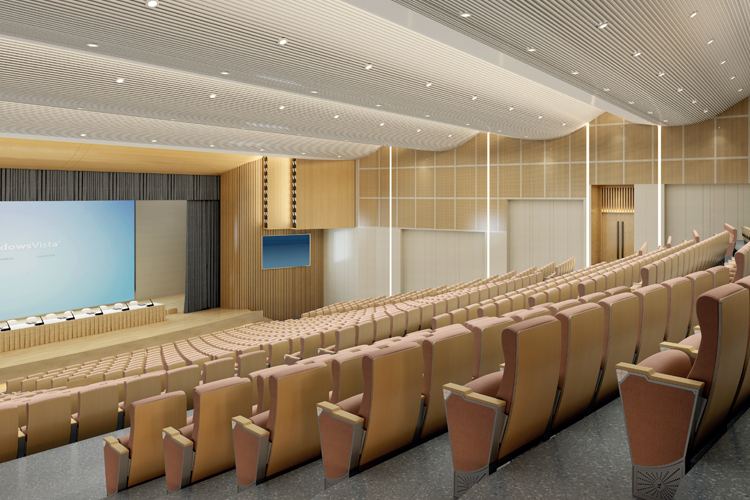
After the initial shortlist, evaluation should move beyond visuals and into project-fit validation: functional alignment, documentation readiness, installation practicality, and long-term operational impact.
Matching Seating Design to Venue Function
Start by confirming the primary use pattern: lecture-heavy, performance-heavy, or multipurpose. A lecture venue may benefit from tablet arms and faster turnover considerations, while a performance venue may prioritize quiet operation and comfort for longer durations.
It also helps to align the auditorium project to the broader campus furnishing plan. Many institutions coordinate procurement across facility scopes—classrooms, public spaces, and student housing—so delivery timing and vendor support can be managed more consistently.
In those cases, related campus packages such as student apartment bunk beds may be planned alongside auditorium installations to reduce scheduling risk and consolidate project coordination.
Reviewing Durability and Compliance Expectations
Auditorium seating often has multiple approval stakeholders: facilities, safety/risk, accessibility, design, and sometimes external reviewers. Procurement teams can reduce friction by confirming what documentation is required (product details, finishes, care guidance, warranty terms, and any testing/compliance references used by the institution).
Durability expectations should be aligned to actual venue traffic and cleaning routines, not to showroom assumptions. That includes evaluating how finishes show wear, how mechanisms behave over time, and what happens when a chair is damaged.
Assessing Installation and Long-Term Use Practicality
Installation details influence both schedule and future serviceability. Anchoring methods, row alignment tolerances, and access for future repairs should be evaluated early—especially for phased renovations where the venue must reopen on a fixed date.
For teams comparing multiple environments and use cases, the decision framework in How to choose the best auditorium chair in different environments can support internal alignment by translating venue differences into specification priorities.
Choosing Auditorium Chairs That Support Better Venue Performance
The best auditorium seating specifications protect the institution long after the ribbon cutting. They support the room’s purpose, reduce operational friction, and maintain user satisfaction under heavy use.
Creating More Functional and Comfortable Audience Spaces
When seating matches the venue’s function and audience behavior, the room becomes easier to operate and more comfortable to use. Circulation improves, distractions drop, and the venue supports its programming without constant adjustments by staff.
Comfort and usability are also reputational factors for institutions hosting public events, guest lectures, and community programming—especially where the venue is used to represent the campus.
Improving Long-Term Project Value Through Better Specification
Long-term value is built through durable construction, serviceable components, consistent finishes, and documentation readiness. Procurement teams typically see better outcomes when they standardize a clear specification, validate installation planning, and confirm how parts and replacements are handled over time.
If you’re finalizing an auditorium seating specification or comparing configurations, Onmuse can support submittal and project coordination conversations; reaching the team is straightforward through the contact form.
FAQ about Auditorium Chairs
Q1. What should buyers consider when sourcing auditorium chairs?
When sourcing auditorium chairs, buyers should focus on layout, durability, and long-term maintenance. Onmuse auditorium seating ensures consistent quality and meets project specifications.
Q2. How can buyers ensure consistent quality across large orders?
To maintain consistency, choose a reliable supplier like Onmuse. This ensures uniform finishes, durable construction, and high-quality production across all auditorium chairs.
Q3. What factors affect the maintenance cost of auditorium chairs?
Long-term maintenance costs are influenced by durability and the availability of replaceable parts. Onmuse auditorium chairs are designed for high-traffic environments, reducing operational costs.
Q4. How do buyers choose the right configuration for their venue?
The right configuration depends on venue type and usage. Onmuse offers flexible auditorium chairs solutions, ideal for lecture halls, multipurpose spaces, and performance venues.